
Content

At Butterfly House (formerly South Bucks Hospice), innovation and compassion go hand-in-hand. For Katie Greig, the hospice’s Head of Lymphoedema Services, the journey to improve patient care began with a simple question: how can we deliver the best, most up-to-date support for those living with lymphoedema?

Thanks to a professional development grant from the National Garden Scheme, Katie was able to complete specialist training and ease pressure on the hospice’s finances – whilst benefiting patient treatment. 

Katie explains how the grant’s impact has already been felt across the hospice – and beyond.
 

Planting the seed

Text

Katie’s path to the National Garden Scheme grant wasn’t a solo venture. “It wasn’t me personally who found out about the grant – it was our senior management, always looking for ways to support us,” Katie recalls. 

The team’s proactive approach led them to a grant provided by the National Garden Scheme via Hospice UK, a funder dedicated to supporting health and nursing charities across the UK – and one of Hospice UK’s biggest supporters since 1996. 

Each year, 3,500 gardens across England and Wales open in support of the scheme, with the monies raised distributed to health and nursing charities.

The case for change

Text

Historically, Butterfly House’s lymphoedema team trained with a school based in Austria. But as Katie stepped into leadership, she noticed a shift: most neighbouring units were now learning from the Lymphoedema Training Academy in England, which offered the latest research and more efficient methods. 

“Their programme was getting quicker results for patients, and the training was over four months rather than a year,” Katie explains. With limited staff and growing patient numbers, she saw an opportunity to enhance care and efficiency.

Katie advocated for the new training, emphasising its benefits: faster staff development, shorter treatment times, and simpler techniques that empower patients to self-manage – a crucial factor for a lifelong condition like lymphoedema. “If we can make it easier for patients to manage, that’s what we’re looking for,” she adds.

In order to benefit from the new training, Katie needed to find a way to fund her study with them. That’s where the National Garden Scheme professional development grant came to the fore.

Image
Image
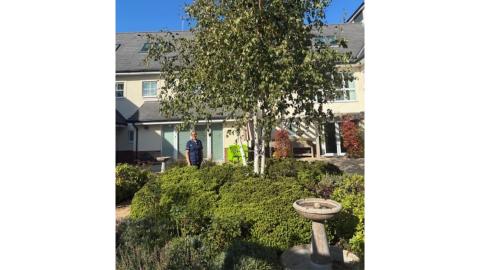
Katie Grieg is Head of Lymphoedema Services at Butterfly House Hospice, and benefited from a National Garden Scheme professional development grant.
Text

"With the new techniques I've learned, it's so much simpler to teach the patients. It's given them a lot more empowerment, really, and that's what I'm looking for, so they can go out and self-manage. That gives them a real confidence in us - knowing that we are constantly learning."
Applying for the grant

Text

Katie explains that she was hands-on in the application process, building a strong business case for the grant. The shorter, focused training meant less time away from families, and lower costs – vital considerations for a charity under financial strain. 

“For me to decide if it was right for future staff,” shares Katie, “I had to train in it myself. Now I can support new team members with confidence.”

The grant’s real-world impact

Text

Since completing the specialist training in April 2025, Katie says that she’s seen a whole bunch of tangible benefits. “We were getting brilliant results before, but these new techniques are so much simpler to teach. It’s given patients more empowerment, and that’s what I’m looking for,” she says. 

The ability to self-manage symptoms builds confidence and trust, and Katie continues to use both old and new techniques, meaning that she and her team can tailor each person’s care to their own needs and treatment journey.

The ripple effect of community support

Text

Katie’s connection to the National Garden Scheme runs deeper than she realised: her own mother actually opens her garden for the scheme. 

“I had no idea that would end up benefiting us,” Katie reflects, “so it’s lovely when people raise money, even though they might not always know exactly where it goes, but knowing it benefits their own communities. My mum’s little garden is beautiful, and if she can help others by opening it, that’s really special.”

Image
Image
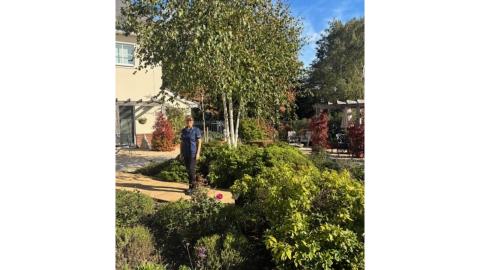
Katie Grieg is Head of Lymphoedema Services at Butterfly House Hospice, and benefited from a National Garden Scheme professional development grant.
Text

"I've only just realised my mum has opened her garden for the National Garden Scheme and I had no idea that I would then end up benefiting from it. Her garden's only little, but it's beautiful and she enjoys it. So if she can do her bit by just getting people round to have a look - finding a different way of people being able to help their wider community - that's just really special."

Gratitude and advice

Text

Asked what she’d say to the National Garden Scheme, Katie is clear – it’s a huge thank you: 

“It’s had a massive impact. Without the grant, I wouldn’t have been able to support new staff or deliver cohesive patient care. Continual development is essential in healthcare – new research is always emerging, and we need to stay on top of it to deliver the best care.”

And her advice to others considering applying for funding? “Give it a go. If you have a good reason and a strong case, go for it. Money is scarce in charities, but these schemes make a massive impact. Keep opening your garden and keep applying!”

Katie’s story is a testament to the power of professional development, community support, and the ongoing pursuit of excellence in hospice care. Thanks to the National Garden Scheme, Butterfly House, now merged with Florence Nightingale Hospice Charity, continues to challenge, improve, and change lives – one garden, one grant, and one empowered patient at a time.

Thank you to Katie for sharing her story.